
The Acropolis
The Parthenon
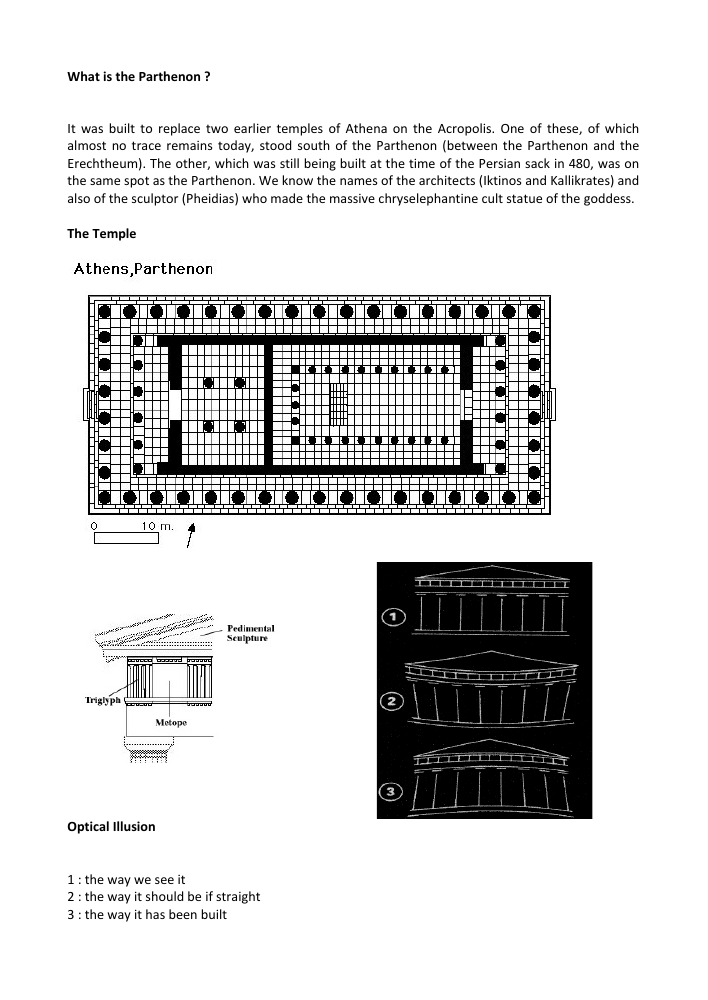
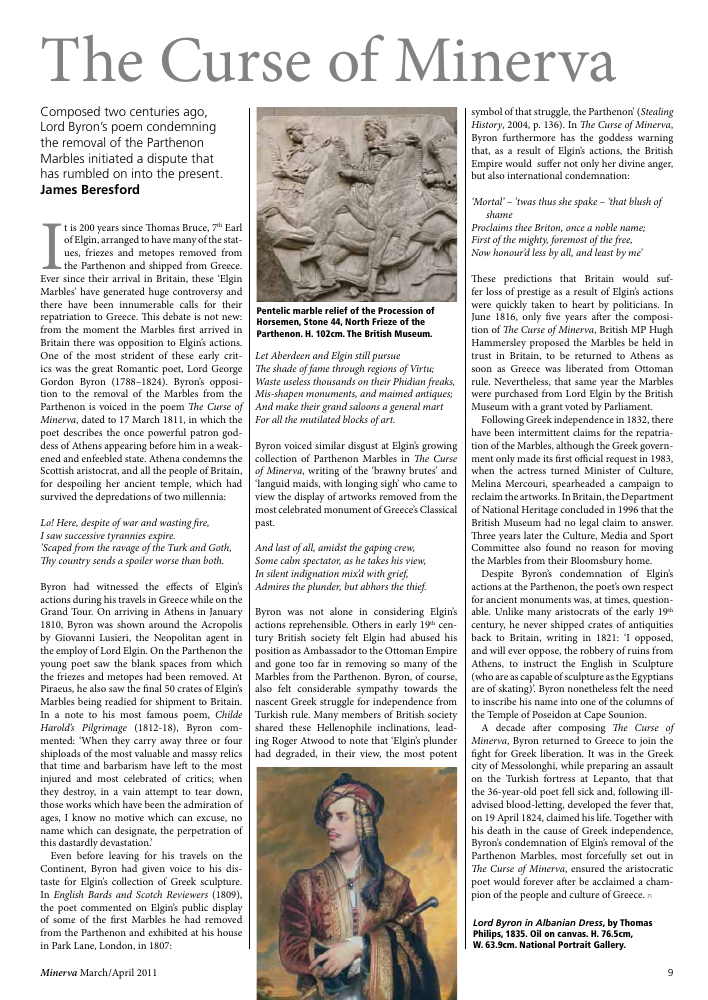
What should be done with the Parthenon marbles?
Group A — Greece
You are part of a delegation sent by Greece to UNESCO to plead for the return of the Parthenon friezes to Greece.
→ List the arguments that will enable you to sway the arbitration in your favour.
→ Anticipate your opponents’ arguments in order to counter them.
Sources
1. Melina Mercouri’s speech
About six months ago I dared to suggest that these marbles should be returned to Greece. Since then, a small storm has been raging. But the interesting thing for me was, following a BBC interview, the hundreds of letters from individuals and organizations in England encouraging me. I see in these letters the love of the English people for justice and beauty. Moreover, Lord Elgin’s sacrilege immediately aroused disapproval in England itself. The British writer Dodwell wrote in horror: "I have known the humiliation of witnessing the of the Parthenon, of its most brilliant sculptures, and the destruction of some of the magnificent architectural parts of the temple." While Lord Byron wrote: "When the wonders of the ages are plundered and the marvels of the centuries, which time and barbarism have spared, there is no excuse, whoever may have committed this cowardly destruction (…). I speak objectively, I am with Greece, and I do not believe that the plundering of India or Attica is to the credit of England."
Lord Elgin announced that his act was motivated by idealism, that it was necessary to save these marbles from "uncultivated hands and indifferent minds". Here I will tell you a very small story. The Acropolis was occupied by Ottoman forces, besieged by the Greek National Liberation Army. The Ottoman occupiers of the Acropolis ran out of ammunition. So they started to destroy the columns to get the lead out and make bullets. The Greeks sent them a message that I think is historic: "Don’t touch the columns of the Acropolis, we’ll send you bullets." And they did. It was these uneducated hands that carried the bullets, and it was these indifferent minds that traded their lives to defend their heritage.
Speech by Melina Mercouri, Minister of Culture and Science of Greece, Mexico City, 29 July 1982.
3. The Marbles and Greek identity
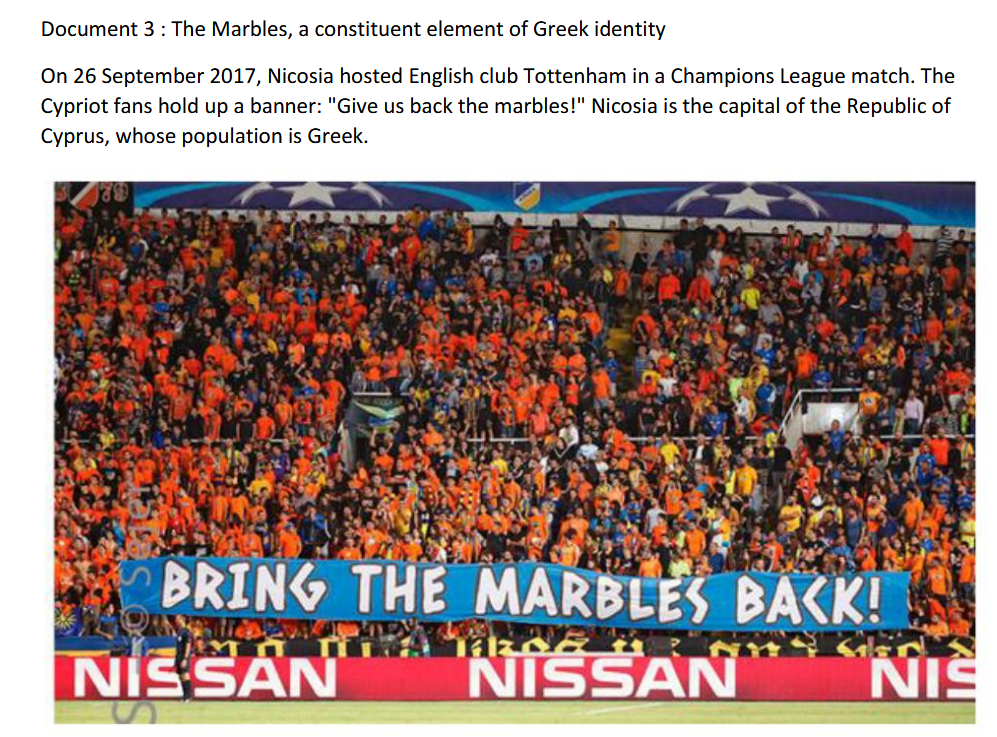
Group B — Great Britain
You are part of a delegation, sent to UNESCO by Great Britain, to plead the case for keeping the Parthenon friezes in the British Museum.
→ List the arguments that will enable you to sway the arbitration in your favour.
→ Anticipate your opponents’ arguments in order to counter them.
Sources
5. Elgin’s removal of the sculptures
The group of artists hired by Lord Elgin arrived in Athens in August 1800. Prudence or caprice, the Disdar, the military governor, demanded a firman (an order issued by the sovereign).
This authorization was obtained without too much difficulty, because the English had just made the French army capitulate in Cairo, and the Sultan had therefore nothing to refuse the British ambassador. (…) In 1816, when the collection was bought by the State (of Great Britain), a commission investigated the value of the marbles and the circumstances of their removal.
Elgin defended himself: "In amassing these relics of antiquity for the benefit of my country, and by saving them from the impending destruction which threatened them inexorably if for many years to come, they would have remained the prey of malicious Turks, who would have mutilated them for vain pleasure or with the aim of selling them piece by piece to passing visitors, I was not driven by the search for personal profit."
These arguments convinced public opinion. Only one voice was heard, that of Hugh Hammersley, a member of the House of Commons, who deplored "the failure of the State to repress this act of plunder" and proposed that "Great Britain hold these marbles in trust only, until the present possessor of the city of Athens, or any other to come, claims them."
Roland and Françoise Étienne, La Grèce antique, archéologie d’une découverte, Découvertes Gallimard, 1990.
6. The British Museum’s arguments — J. Lubbock
J. Lubbock summarises the arguments of the British Museum and its director David Wilson for leaving the marbles in London and also gives his opinion.
"We have absolutely no intention of returning the Elgin Marbles," say Wilson and his trustees; however, they will consider the return of minor parts of monuments and some objects of major religious importance. They insist that their legal title is valid, that the collection has become, over time, more a part of Britain’s cultural heritage than its country of origin, that Elgin preserved the marbles from destruction, and that the British Museum has retained them. Above all, they argue that to return even a single object would be like if everything would become worth taking, and the British Museum, the greatest museum representative of humanity’s cultural heritage, would be destroyed, a loss greater than that of the Parthenon, comparable to the loss of the Library of Alexandria. Finally, clause 5 of the British Museum’s 1963 statutes prevents them from disposing of anything other than a duplicate piece. An amendment would place the museum at the mercy of any government that wished to put a soft touch on a bilateral agreement. (…)
J. Lubbock, New Statesman, 20 June 1983, quoted in Roland and Françoise Étienne, La Grèce antique, archéologie d’une découverte, Découvertes Gallimard, 1990.
Group C — UNESCO
You have been appointed to a UNESCO mission to arbitrate in the dispute between Greece and Great Britain over the Parthenon friezes.
Before hearing the two parties, using the various examples provided, you must think about the question of the restitution of works of art.
→ Should works of art be systematically returned to their country of origin?
→ If the issue has to be dealt with on a case-by-case basis, what principles could guide the decisions?
Sources
9. Melina Mercouri’s speech
About six months ago I dared to suggest that these marbles should be returned to Greece. Since then, a small storm has been raging. But the interesting thing for me was, following a BBC interview, the hundreds of letters from individuals and organizations in England encouraging me. I see in these letters the love of the English people for justice and beauty. Moreover, Lord Elgin’s sacrilege immediately aroused disapproval in England itself. The British writer Dodwell wrote in horror: "I have known the humiliation of witnessing the of the Parthenon, of its most brilliant sculptures, and the destruction of some of the magnificent architectural parts of the temple." While Lord Byron wrote: "When the wonders of the ages are plundered and the marvels of the centuries, which time and barbarism have spared, there is no excuse, whoever may have committed this cowardly destruction (…). I speak objectively, I am with Greece, and I do not believe that the plundering of India or Attica is to the credit of England."
Lord Elgin announced that his act was motivated by idealism, that it was necessary to save these marbles from "uncultivated hands and indifferent minds". Here I will tell you a very small story. The Acropolis was occupied by Ottoman forces, besieged by the Greek National Liberation Army. The Ottoman occupiers of the Acropolis ran out of ammunition. So they started to destroy the columns to get the lead out and make bullets. The Greeks sent them a message that I think is historic: "Don’t touch the columns of the Acropolis, we’ll send you bullets." And they did. It was these uneducated hands that carried the bullets, and it was these indifferent minds that traded their lives to defend their heritage.
Speech by Melina Mercouri, Minister of Culture and Science of Greece, Mexico City, 29 July 1982.
10. The British Museum’s arguments — J. Lubbock
J. Lubbock summarises the arguments of the British Museum and its director David Wilson for leaving the marbles in London and also gives his opinion.
"We have absolutely no intention of returning the Elgin Marbles," say Wilson and his trustees; however, they will consider the return of minor parts of monuments and some objects of major religious importance. They insist that their legal title is valid, that the collection has become, over time, more a part of Britain’s cultural heritage than its country of origin, that Elgin preserved the marbles from destruction, and that the British Museum has retained them. Above all, they argue that to return even a single object would be like if everything would become worth taking, and the British Museum, the greatest museum representative of humanity’s cultural heritage, would be destroyed, a loss greater than that of the Parthenon, comparable to the loss of the Library of Alexandria. Finally, clause 5 of the British Museum’s 1963 statutes prevents them from disposing of anything other than a duplicate piece. An amendment would place the museum at the mercy of any government that wished to put a soft touch on a bilateral agreement. (…)
J. Lubbock, New Statesman, 20 June 1983, quoted in Roland and Françoise Étienne, La Grèce antique, archéologie d’une découverte, Découvertes Gallimard, 1990.
11. Returning Africa’s cultural heritage
Inspired by the procedures for reclaiming works stolen by the Nazis or the return of sarcophagi to Egypt by major American museums, some Africans now believe that the continent needs its heritage to move forward, with 90% of the major pieces of classical African art outside Africa. But how do we get it back? First, there is the gentle way, that of Marie-Cécile Zinsou, director of the foundation that bears her name in Cotonou (Benin). Her parents (…) have started a collection. She talks about the great Dogon Janus, offered in 1966 by Léopold Sédar Senghor to André Malraux, or the throne of Behanzin, bought in an auction in 2004. The surrender of this king of Dahomey (the former Benin) in 1894 was the occasion for the plundering of the works: thrones, hangings, bas-reliefs, palace doors, weapons, figurines, jewellery, masks and statuettes were sent to France and are today, in part, in the Quai Branly Museum, which has 5556 Beninese objects. (…)
There is also the radical way, for the moment theoretical. It is that of the Representative Council of Black Associations in France (CRAN), chaired by Louis-Georges Tin. For him, the only honourable outcome is a "complete" restitution. In other words, to empty the museum wanted by Jacques Chirac. (…) The recurring argument is that African museums do not meet security and conservation standards. The French authorities readily repeat that Benin has never officially requested the return of its works. This was indeed the case until 27 July 2016. On that day, the Council of Ministers, in Cotonou, decided to take the necessary steps for certain restitutions, a thunderclap in the middle of summer.
Serge Michel, “Et si l’on rendait à l’Afrique son patrimoine ?”, Le Monde, 30 July 2016.
12. ARTnews — A restitution protest at the Quai Branly Museum
13. Emmanuel Macron and the return of African artifacts
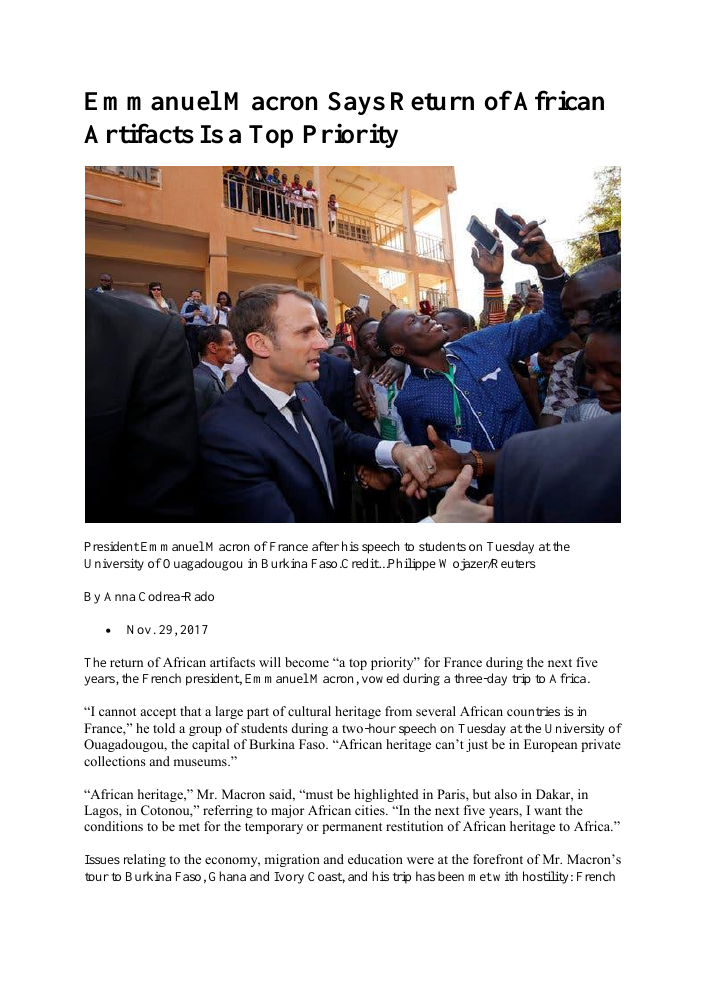
Anna Codrea-Rado, The New York Times, 29 November 2017.

